by: The Workshop Team, May 21, 2026
As Pentecost approaches, I’ve been reflecting on a question that keeps returning. If the Holy Spirit is still alive in the Church, how do we recognize His voice today?
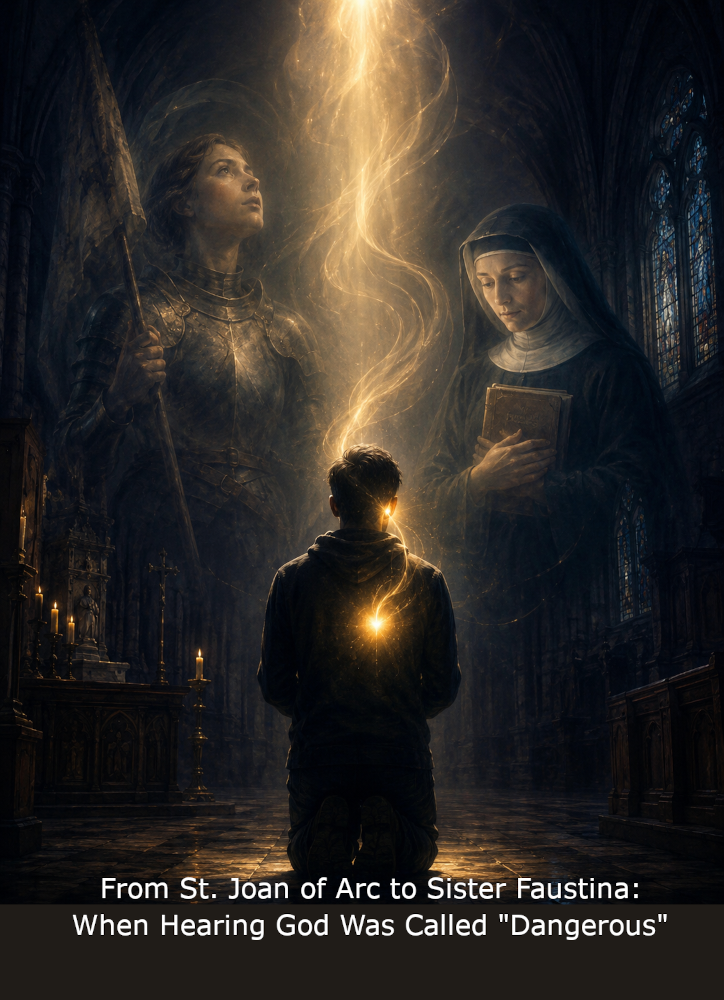
It is one of the quiet ironies of Church history that some of her most beloved saints were once regarded as dangerous, mistaken, or even deluded… precisely because they claimed that God was speaking to them.
Today, their writings are read, their feast days celebrated, and their devotions embraced. Yet in their own lifetimes, their interior experiences were often met not with trust, but with suspicion. This raises a question that feels especially urgent as Pentecost approaches.
If the Holy Spirit is truly alive in the Church, should not the voice of God remain alive, vibrant, and active in the present, and not only in history?
Pentecost was not simply an event, it was a pattern. The Holy Spirit was poured out not only upon Peter and the Apostles, but upon all who were gathered. "All were filled with the Holy Spirit." (Acts 2:4).
The implication is profound. It means the Holy Spirit was not given to an elite few or only to the apostles or to the present day Church hierarchy. It is given to all who live in the Spirit. The Spirit is not only a reality of the early Church but it is a reality for the present. It remains with those who believe and receive it.
If the Church is still guided by the Spirit, then that guidance must remain: living, dynamic, personal, as well as communal.
As Ralph Martin (2011) observed, the direct workings of the Holy Spirit have often been "forgotten or overshadowed by an excessive emphasis on the institutional and hierarchical." In practice, this creates a subtle imbalance because the Spirit is affirmed in theory, but restrained in experience. And when the inner movement of the Spirit becomes suspect, something essential is lost.
"Dangerous Saints who Heard God"
History offers a disturbing pattern. Many who are now recognized as saints were once treated with suspicion, or worse, their lives made miserable because of their claims of divine encounter.
St. Joan of Arc – executed after being judged for claiming to hear divine voices; later canonized
St. Teresa of Ávila – investigated and suspected of spiritual deception for her visions of Christ before being declared a Doctor of the Church
St. John of the Cross – imprisoned by his own religious community due to deep contemplations that can let him commune with Christ
St. Catherine of Siena – examined for her visions and bold spiritual claims
St. Margaret Mary Alacoque – dismissed for her vision of the Sacred Heart, and was later embraced by the Church
St. Faustina Kowalska – her channeled writings from the Lord of Mercy was suppressed by Rome before later being vindicated and canonized.
St. Padre Pio – restricted from ministry for years under suspicion due to his visions, bilocation, and healing gifts
This pattern does not prove that discernment is unnecessary. But it does reveal something more subtle, and more unsettling; that institutional suspicions and mediated discernment can be mistaken. Sometimes profoundly so.
The Role of Conscience and the Inner Voice
The Catechism teaches that "conscience is the most secret core and sanctuary of a man. There he is alone with God whose voice echoes in his depths." (CCC 1776–1778)
Scripture reinforces this:
“My sheep hear my voice.” (John 10:27)
“Those who are led by the Spirit of God are children of God.” (Romans 8:14)
“We must obey God rather than men.” (Acts 5:29)
Christian obedience, therefore, is not purely institutional, but it is also spiritual. It involves the capacity to listen, discern, and respond to the movement of God within.
From Infant Faith to Mature Discernment
In the early stages of faith, believers depend heavily on structure, doctrines, and external authority. This is necessary. But this should not be forever. The New Testament calls believers beyond this stage into maturity, where a life where the Spirit is not only believed in, but listened to. The role of the Church is not to replace this inner listening with the Magisterium. They should help the faithful to form the listening skills, guide, and discern it. When the inner communion with the Holy Spirit is lost and replaced by mere institutional obedience, faith is no longer alive. It becomes mechanical, fear-driven, and detached from living encounter.
The real question for our time is not whether the Holy Spirit speaks. The real question is “have we become uncomfortable with how the Holy Spirit speaks?
History suggests that conflict arises whenever the Holy Spirit speaks personally, and the message precedes institutional confirmation or the initiative comes from outside expected structures.
Toward a Living Pentecost
Renewal does not require abandoning structure in institutions. But neither can it mean silencing the Spirit in the name of order. A mature Church should be able to hold both structure and spontaneity; authority and discernment; and tradition and living encounter.
An educated, Spirit-filled laity is not a threat. It is, perhaps, exactly what Pentecost intended.
If the Spirit was never confined to history, then we must ask whether we have fully reckoned with what Scripture says about how widely He intends to speak.
The Urgent Need to Hear the Voice Today
Hearing the voice of God is called by St. Paul as the Gift of Prophecy. Scripture does not present prophecy as a rare or fading phenomenon, but as a defining mark of the Spirit’s presence in the “last days.” Through the prophet Joel, God promises a widespread outpouring: sons and daughters prophesying, the young seeing visions, and the old dreaming dreams (Joel 2:28–29). At Pentecost, Peter declares that this promise is not distant, but already unfolding (Acts 2:16–18). The New Testament continues this trajectory, that St. Paul encourages believers to desire the gift of prophecy (1 Corinthians 14:1), while Christ Himself warns that prophetic voices, both true and false, will increase (Matthew 24:24).
Taken together, the pattern is unmistakable: the movement of the Holy Spirit is not diminishing, but expanding. The rise of prophetic experience, therefore, is not an anomaly to suppress, but a reality to discern. For when truth becomes obscured, interpreted, or mediated imperfectly, the Holy Spirit has often responded, not by withdrawing, but by speaking more directly among the people (Isaiah 44:3).
Praise be to the Lord Christ!
------------
𝗥𝗲𝗳𝗲𝗿𝗲𝗻𝗰𝗲:
Martin, R. (2011). 𝐴 𝑁𝑒𝑤 𝑃𝑒𝑛𝑡𝑒𝑐𝑜𝑠𝑡. Renewal Ministries, MI.